 EN

Structural Wall Anchoring and Working Clearance Regulations
Walking onto a commercial job site or an industrial plant floor, a seasoned electrical inspector can spot a rushed panelboard job before even opening the enclosure door. When contractors begin installing electrical panel assemblies across masonry, drywall stud frames, or structural steel columns, mechanical alignment and working clearance dictate long-term safety just as much as wire gauge selection. Under NFPA 70 National Electrical Code Article 110.26 and international IEC 60364 installation standards, field crews must maintain a dedicated working space in front of the enclosure, alongside a ninety-degree door swing arc and standardized mounting heights so operators can reach the highest circuit breaker handle without standing on a ladder. Beyond spatial geometry, the physical rigidity of the sheet-metal backbox determines whether the internal DIN rails and busbar supports stay flat once anchored. If a carpenter builds an uneven stud pocket or a mason leaves rough mortar bumps across a concrete block wall, tightening four corner anchor bolts on a flimsy cold-rolled box twists the entire chassis. That subtle diagonal warp throws the hinged cover out of alignment and puts uneven mechanical stress on rigid copper busbars before a single feeder cable is ever landed.
Flush-Mounted Versus Surface-Mounted Enclosure Engineering
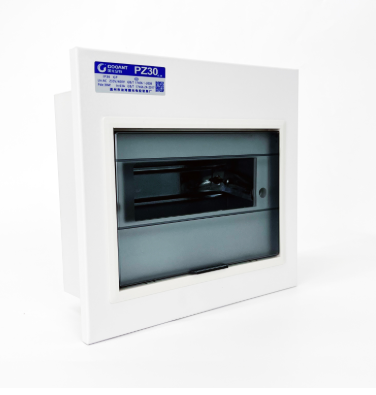
Choosing how the enclosure meets the building structure changes both the sheet-metal fabrication requirements and the chemical corrosion risks behind the wall. In commercial lobbies, hospitals, and residential corridors, architects almost always call for flush-mounted cabinets recessed neatly into wet plaster or concrete block cavities. Fresh Portland cement mortar and damp gypsum plaster are highly alkaline and hold trapped moisture for weeks during construction curing. Burying a standard painted steel backbox directly into wet masonry invites rapid alkaline paint saponification and hidden back-wall rust. Specifying a heavy-gauge hot-dip galvanized steel backbox prevents this hidden structural decay because the metallurgical zinc layer resists wet mortar corrosion and protects raw knockout edges inside the dark wall cavity.
| Installation Configuration | Sheet-Metal Structural Demand | Cable Entry & Conduit Routing | Thermal Dissipation Path | Typical Building Deployment |
|---|---|---|---|---|
| Flush-Mounted (Recessed in Masonry/Studs) | High lateral stiffness to resist wet mortar compression | Concealed PVC or EMT conduits fed through top/bottom knockouts | Heat radiates primarily through front hinged trim frame | Office corridors, residential apartments, hospitals |
| Surface-Mounted (Bolted to Wall/Unistrut) | Strong rear mounting flanges and corner weld integrity | Exposed rigid steel conduits, cable trays, or gland plates | Full five-sided convection around galvanized cabinet body | Factory floors, basement utility rooms, parking garages |
| Free-Standing Floor/Pedestal Mount | Heavy folded channel base and reinforced lifting lugs | Bottom trench cable entry through removable gland plates | Natural chimney draft or forced ventilation louvers | Main switchgear rooms, automated logistics hubs |
The engineering comparison above highlights a major field trade-off: because a recessed flush-mounted box loses four sides of natural air convection inside an insulated wall cavity, electrical designers must size the galvanized enclosure with extra internal air volume to keep breaker operating temperatures compliant with IEC 61439 and GB/T 7251 temperature-rise limits.
Torque Calibration, Phase Balancing, and Grounding Continuity
Once the galvanized chassis sits plumb and level on the wall, internal conductor termination separates reliable distribution networks from fire hazards. Field termination follows three strict electromechanical practices:
-
Calibrated torque wrench tightening on busbar and breaker lugs: Under-tightening a phase terminal creates high-resistance micro-arcing and localized Joule heating, whereas over-tightening strips brass threads or crushes stranded copper conductors, causing the joint to loosen after a few thermal expansion cycles.
-
Three-phase load balancing across busbar stabs: Distributing high-draw continuous loads evenly across phases L1, L2, and L3 minimizes neutral return current and prevents localized hot spots along the vertical bus assembly.
-
Unbroken equipotential chassis bonding: Connecting the incoming main grounding conductor to the neutral bar at the service entrance, and bonding the removable hinged door to the galvanized steel backbox via braided copper straps, ensures fault currents trip upstream protection instantly.
Field Lessons from a Chicago Commercial Office and Light Industrial Retrofit
Skipping structural shimming and using sub-standard sheet metal during a fast-track buildout can delay a building occupancy permit by weeks. During a multi-story commercial office and light assembly retrofit in suburban Chicago, an electrical subcontractor mounted forty recessed sub-panels into newly poured masonry shaft walls and damp drywall partitions. To trim material expenses, the subcontractor purchased lightweight, ungalvanized painted steel boxes. Within three weeks of plastering, two major field failures surfaced during pre-commissioning inspections. First, as the wet masonry mortar cured and expanded around the recessed boxes, the thin side walls bowed inward by six millimeters, preventing electricians from snapping the dead-front safety covers over the miniature circuit breakers. Second, moisture wicked inside the wall cavities had already rusted the unplated knockouts and compromised the grounding continuity between the backboxes and the conduit locknuts. Ripping out the deformed shells and installing rigid, heavy-gauge galvanized sheet enclosures with removable adjustable mounting pans saved the project schedule. The folded galvanized steel frames resisted wall compression without flexing, while the conductive zinc surface guaranteed solid metal-to-metal grounding continuity across every conduit hub.
Site Preparation Limits and Sourcing Precision Galvanized Enclosures
Even a master electrician cannot compensate for poor architectural coordination. Enclosures should never be mounted directly beneath overhead domestic water pipes, steam valves, or air-conditioning condensate traps without drip shields, nor should panels be crammed behind swinging hallway doors that violate emergency access rules. Pairing disciplined field workmanship with dimensionally accurate, corrosion-resistant galvanized sheet hardware ensures that an installation passes inspection on the first walkthrough and runs trouble-free for decades.
For electrical contractors, MEP engineering consultants, and wholesale distributors seeking dependable enclosure hardware, Guoguang brings over two decades of specialized manufacturing experience in galvanized sheet distribution boxes. Operating with first-class production machinery under strict ISO 9001 quality management systems and national GB standards, the factory delivers rugged, precision-engineered panel enclosures built to simplify field installation and safeguard power distribution networks worldwide.
Table of Contents
- Structural Wall Anchoring and Working Clearance Regulations
- Flush-Mounted Versus Surface-Mounted Enclosure Engineering
- Torque Calibration, Phase Balancing, and Grounding Continuity
- Field Lessons from a Chicago Commercial Office and Light Industrial Retrofit
- Site Preparation Limits and Sourcing Precision Galvanized Enclosures