 EN
EN

What a Main Distribution Board Really Does
A main distribution board sits between the utility supply or transformer and the downstream panelboards. It takes one large incoming feed, splits it into several smaller circuits, and provides a single place for switching, protection, and metering. In commercial buildings, industrial plants, and data rooms, the main distribution board often defines the reliability ceiling for the whole electrical system. If the main board trips, every subpanel fed from it loses power. That is why allocation decisions made at this stage matter more than most people expect.
The term main distribution board gets used loosely. Some sites call it an MDB, main switchboard, or main panel. The hardware can vary, but the job stays similar: receive power, distribute power, and survive faults long enough for upstream protection to clear them. A board that only looks tidy in a drawing can still fail in service if thermal, mechanical, and short-circuit realities are ignored.
Incoming Feed, Busbars, and Breaker Coordination
The incoming section is not just a big breaker. It includes the main lug or bus connection, surge protection, metering, and often a disconnect means. Busbar sizing needs to match the calculated load and the available fault current. A common mistake is sizing busbars for normal current only, then discovering during a short-circuit study that the assembly cannot withstand the let-through energy.
Coordination between the main breaker and downstream breakers decides whether a fault trips only the nearest breaker or takes out the whole board. Selective coordination is easy to claim and harder to prove. Manufacturers publish time-current curves, but real coordination depends on breaker models, settings, cable lengths, and transformer impedance. In a 2022 retrofit at a chemical plant in southern China, engineers found that two downstream feeders had been added without updating the coordination study. A minor fault in a pump circuit tripped the main breaker, shutting down unrelated process lines. The fix was not exotic: recalculate fault levels, adjust settings, and replace one undersized breaker frame.
Load Allocation Without Guesswork
Power allocation is a balancing act between capacity, redundancy, and future growth. Every feeder should have a clear purpose, a calculated demand, and a realistic spare margin. Loads that cycle, such as compressors, welders, and large HVAC units, deserve separate attention because their starting currents can be several times their running current.
A practical allocation review usually checks:
-
Continuous versus noncontinuous load definitions.
-
Harmonic-producing loads and neutral sizing.
-
Motor starting voltage drop at the farthest terminal.
-
Spare breaker spaces and busbar reserve.
-
Arc flash energy at working distances.
The table below shows a simplified comparison of common distribution levels. Values are typical planning figures, not code requirements, and actual designs must follow local codes and project studies.
| Distribution level | Typical voltage | Typical fault withstand focus | Common enclosure format | Planning spare capacity |
|---|---|---|---|---|
| Main distribution board | 480 V or 400 V | High, often 50 kA or more | Floor-standing metal enclosure | 20% to 30% |
| Sub-distribution board | 480 V or 400 V | Medium, 10 kA to 35 kA | Wall-mounted or floor-standing | 15% to 25% |
| Final panelboard | 208 V or 230 V | Lower, 5 kA to 10 kA | Compact wall-mounted | 10% to 20% |
Those numbers shift with transformer size, utility fault duty, and conductor length. Treat them as a starting point for review, not a stamp of approval.
Enclosure Material and Site Conditions
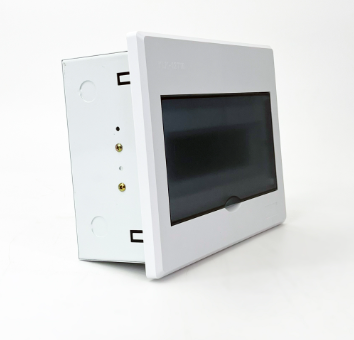
The enclosure is part of the electrical assembly, not a cosmetic box. In humid, coastal, or chemical environments, a thin painted panel can rust from the inside out. Galvanized sheet offers a zinc layer that sacrifices itself before the base steel, which helps in damp rooms and outdoor-adjacent installations. It is not a magic coating. Cut edges, weld seams, and mounting holes still need proper treatment, and aggressive chloride or acid atmospheres may require stainless steel or additional sealing.
Temperature rise inside the board also depends on enclosure design. Tight layouts with high breaker density can trap heat. Ventilation, internal separation, and cable bending space matter as much as the nominal current rating. IEC 61439-1 and IEC 61439-2 set verification requirements for assemblies, including temperature rise and short-circuit withstand. UL 67 and GB/T 7251.1 play similar roles in their respective markets. A certified assembly is not a guarantee of a good installation, but it gives a documented baseline.
Standards, Testing, and Fault Current Reality
Short-circuit current is where many designs get humbled. A board rated for 4000 A continuous may still fail if its busbar supports, insulators, and breaker terminations cannot handle the peak let-through current. Type tests cover representative designs, but site conditions can change the outcome. Cable entries, foreign objects, loose torque, and missing barriers all reduce performance.
Arc flash studies are another part of the picture. IEEE 1584 provides methods for estimating incident energy, and NFPA 70E sets workplace safety practices. Those studies often recommend remote racking, current-limiting protection, or maintenance switches. The main distribution board is usually a high-energy location, so labeling and safe work distances deserve attention early in the project.
Bringing the Design Into the Real World
A main distribution board works best when the design leaves room for reality. Contractors need bending space, electricians need torque access, and future teams need clear labeling. Spare capacity should be planned, but not so much that the board becomes a costly empty room. Documentation should include single-line diagrams, breaker schedules, torque tables, and coordination study results.
For projects using galvanized enclosures, Guoguang Electric has specialized in distribution box fabrication since 2000, with ISO 9001 and GB-oriented production controls, serving buyers who need consistent sheet metal quality and practical delivery support. The right main distribution board is not the biggest one on the market. It is the one that matches the fault duty, load profile, environment, and maintenance strategy of the site.